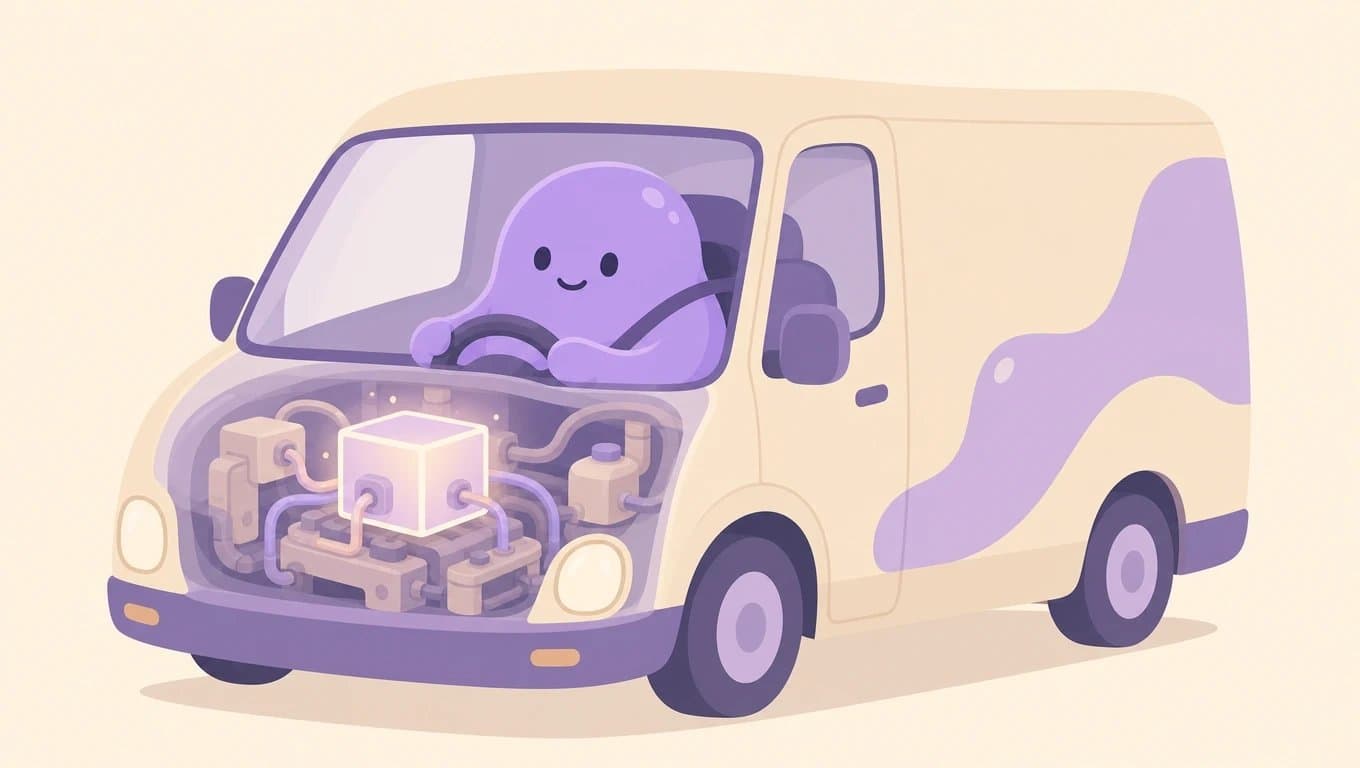
A model is an engine; an agent is a vehicle. What the Zapians harness does, what a digital employee's memory really is, and why your data is safer behind the API door.
At Zapians we build digital employees, and the question companies ask us most isn't about pricing or features: it's what exactly an AI agent is. The short answer: a model is an engine and an agent is a vehicle. The long answer is this article — and it also explains what happens to your data along the way.
The engine first: what a model is
A language model is a file of numbers — billions of parameters — that does exactly one thing: given a sequence of words, predict the next one. That file is frozen: it doesn't learn from your conversations, doesn't change between questions, does nothing but complete text. If you want the full story of how that file comes to exist and how it's trained, I told it on my personal blog; here I care about what comes next.
Because an engine alone takes nobody anywhere. A model answers once and switches off: it doesn't browse, doesn't execute, doesn't remember, doesn't wait. And running a company's back office doesn't need loose answers — it needs things done.
What an AI agent is
An agent is a model placed inside a working loop, with three pieces the bare model doesn't have. At Zapians we call that loop the harness, and it's where most of our engineering lives:
- A goal that persists: "reconcile this week's payments", "process the invoices that arrived by email". Not a question — an assignment.
- Tools: actions the agent can request — read an email, query a database, issue a document, notify on WhatsApp. The model doesn't execute them: it requests them, and the Zapians harness executes, validates, and feeds the result back.
- The loop: with each result, the agent decides the next step. Act, observe, correct, until the assignment is closed. If something goes off-script, it escalates to a person instead of improvising.

The difference sums up cleanly: a model takes a question and produces an answer; an agent takes a goal and produces a sequence of actions with a verifiable result. A Zapians digital employee is that, plus a job description: a defined role, your company's procedures, and bounded responsibilities.
Memory isn't what you think
When a Zapians digital employee "remembers" a supplier, a deadline or a preference, the model learned nothing — the system remembers. Before each task, the harness injects a dossier into the model: the company's context, the relevant history, the rules of the role. Memory is a document read to the engine before it works, not a change in the engine.

This apparent technicality is an architecture decision with a direct consequence: that memory lives in each company's private database, managed by Zapians — not on the model provider's servers. It can be audited, exported and deleted. What your digital employee knows about your company is yours.
What about my data? The two doors
Here's the part almost nobody explains. AI companies run two different data regimes. The consumer door — the free chat in your browser — may use your conversations for training: ChatGPT does it by default unless you turn it off, Claude asks you, and Gemini uses your activity unless you switch it off. The API door — the one used by products built on these models — runs on a different contract: that traffic is not used for training and retention is short.

Zapians always enters through the second door. The model is consumed via API, and everything else — tools, memory, interactions, logs — runs through the harness and stays in each company's private databases. Which means pasting a client's contract into a free chat exposes your data more than handing it to a Zapians digital employee: the chat may have permission to train on it; the digital employee processes it through a commercial channel that doesn't train, and files it in a database you control.
And for companies where even that isn't enough — regulated data, information that can't leave the building — the next step already exists, and Zapians works with it: open models deployed on private servers. The full digital employee, with the information never crossing the company's door.
To decide with clarity
If you're evaluating "adding AI" to your company, these three distinctions are worth more than any demo: the model is the engine and belongs to a provider; the agent is the vehicle and is defined by whoever builds the harness; and your data follows the contract of the door it enters through. When you compare alternatives, ask about all three. At Zapians the answers are: the best available models, our own harness running your company's rules, and your data in your database — or on your servers.